
Introduction
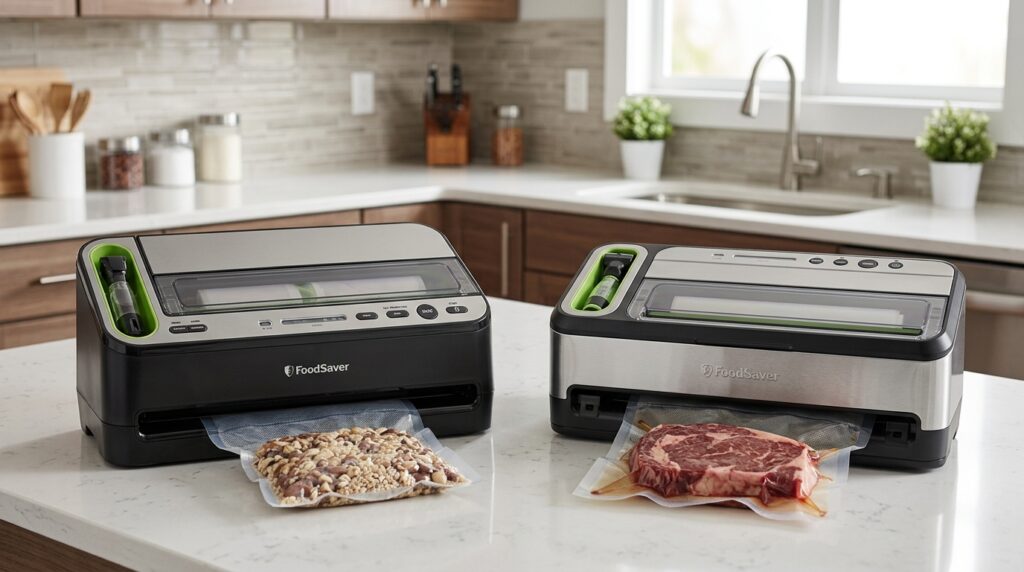
The FoodSaver V4400 and V4840 look almost identical on paper. Both are 2-in-1 automatic countertop sealers with a built-in handheld sealer, moisture detection, and roll storage. So when you’re comparing FoodSaver V4400 vs V4840, the real question isn’t “which one works better” — it’s “what’s actually different, and is it worth paying for?”
One notable listed difference is that some V4840 retailer listings mention “3 custom settings,” a feature not identified in the V4400 information reviewed for this comparison. This guide separates confirmed specifications from retailer claims and explains which model makes more sense for different buyers.
Model availability note: Availability and pricing for these FoodSaver models can vary by retailer, so verify the exact model number, included accessories, and warranty terms before purchasing.
Disclosure: This article contains affiliate links. If you buy through them, FreshSealLab may earn a commission at no extra cost to you.
Quick Verdict: Which One Should You Buy?
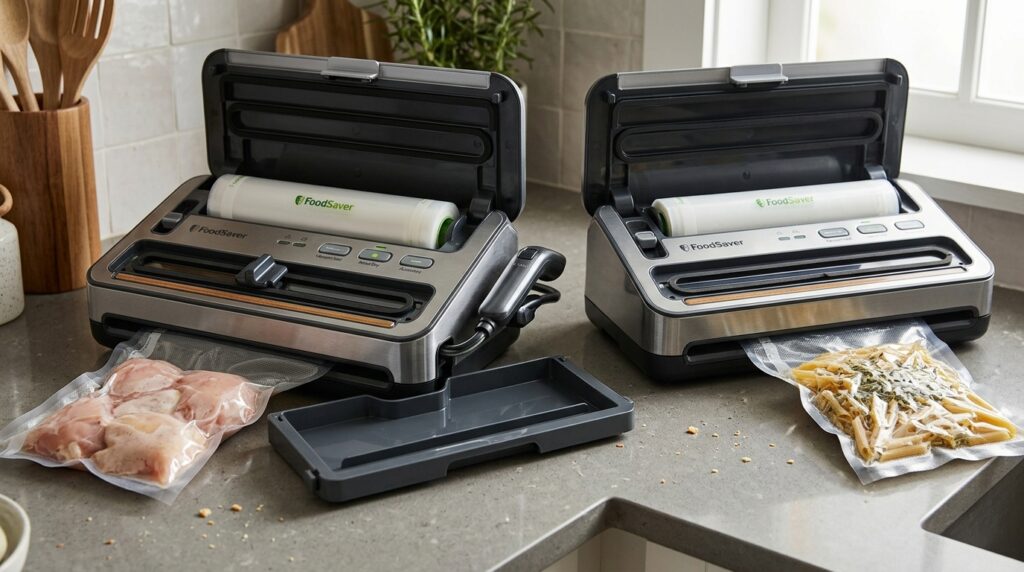
Best overall: No confirmed performance gap exists between these two models based on available manufacturer and retailer data. Neither has a clear, verified edge in sealing power.
Best for budget: V4400 — if it is meaningfully cheaper than the V4840 and you don’t need the V4840’s listed custom-setting feature. Prices vary by retailer, so check current listings before deciding.
Best for frequent use: Tie. Both use the same core auto-detection mechanism, and no independent testing separates them on durability or repeat use.
Best for varied food types: V4840 — some retailer listings mention “3 custom settings,” but the exact functions aren’t clearly documented in the sources reviewed.
Best for warranty and support: Tie — both are listed with a 5-year limited warranty in the sources reviewed. Confirm the warranty terms for the exact model before purchase.
Best for typical home use: Either model works fine for standard dry and semi-moist sealing. The choice mostly comes down to price and whether the extra settings matter to you.
Neither model has independently verified suction data in the sources reviewed. Both are listed with moisture-detection features and removable drip trays, although some design details vary by model and retailer listing. Third-party reviews suggest both may still struggle somewhat with very wet foods.
Check Price on Amazon FoodSaver V4400,
or
Check Current Price on the FoodSaver V4840.
FoodSaver V4400 vs V4840: Key Differences
| Spec | V4400 | V4840 |
|---|---|---|
| Current price | Verify at time of purchase | ~$219.99 at one retailer (price may change) |
| Vacuum/suction rating | Not disclosed | Not disclosed |
| Sealing modes | Auto dry/moist detection | Auto dry/moist detection + “3 custom settings” (manufacturer claim) |
| Handheld sealer | Built-in, retractable | Built-in, retractable |
| Bag compatibility | 8″ and 11″ rolls, pre-made bags, zipper bags, containers | Same |
| Drip tray | Removable, dishwasher-safe | Removable, dishwasher-safe, pull-out drawer design |
| Roll storage/cutter | Built-in | Built-in |
| Warranty | 5-year limited | 5-year limited |
| Starter kit | 11″x10′ roll, quart/gallon bags and zipper bags | Same kit composition |
Most of this table is functionally similar. Based on the overlapping features and specifications reviewed, the two models appear to use a very similar design approach rather than representing two substantially different machines. The main decision points are price and the V4840’s listed “custom settings” feature. The pull-out drawer drip tray on the V4840 is a minor design difference worth noting, but that detail comes from retailer copy rather than a hands-on comparison.
Vacuum and Sealing Performance
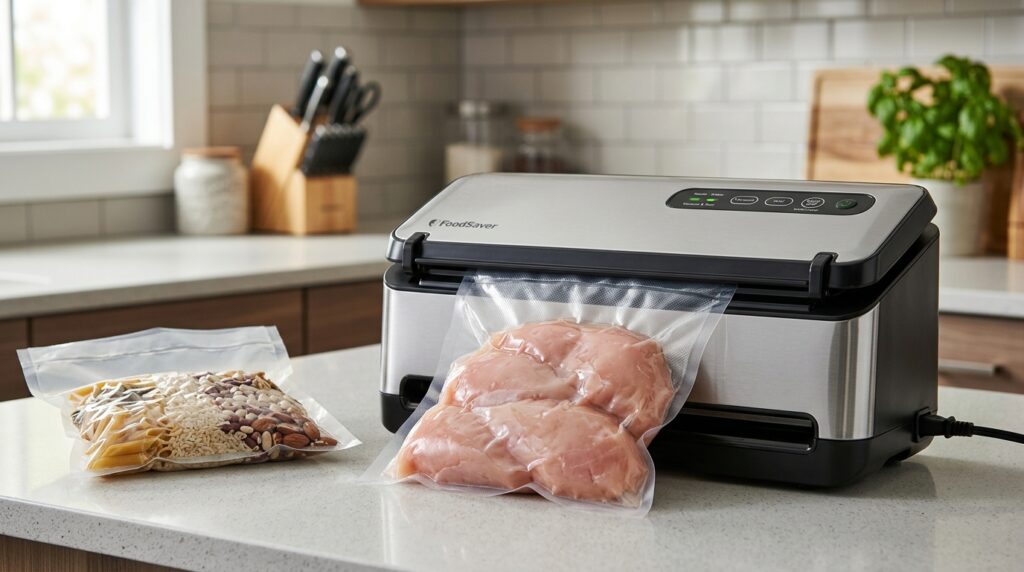
Both models use the same basic system: a heat-seal strip paired with an automatic vacuum chamber that detects when a bag is inserted. That’s a confirmed manufacturer spec for both units.
What’s missing from both listings is any disclosed suction or CFM (cubic feet per minute) figure. Neither FoodSaver nor major retailers publish this number for either model, so it’s Unknown/Unverified — there’s no basis to say one pulls a stronger vacuum than the other.
FoodSaver’s marketing states its systems can keep food fresh “up to 5x longer” in the freezer and “up to 2x longer” in the fridge or pantry compared to ordinary storage. This is a manufacturer claim, not the result of independent lab testing, and it applies broadly across FoodSaver’s product line rather than being specific to either model. Understanding how vacuum sealing extends freezer storage life can help set realistic expectations regardless of which model you choose.
One third-party review site reported the V4400 pulling out roughly two grams of liquid during a wet-food seal test. That’s a single reviewer’s observation, not a controlled lab result, and it shouldn’t be treated as a spec. Still, it is a useful data point for the V4400. Because comparable wet-food testing was not found for the V4840, the result should not be used to predict identical performance from both models. Wet or liquid-heavy foods may be a challenge for either one.
Sealing Modes and Food Types
Dry Foods
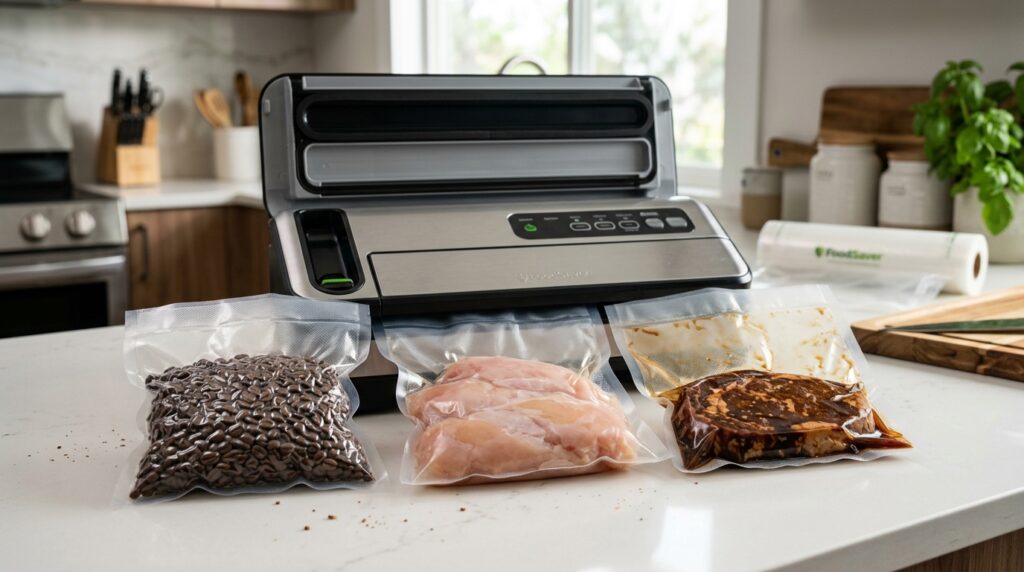
Both models handle dry foods the same way, using automatic dry-mode detection built into the shared FoodSaver platform. No evidence points to an advantage either way. If you’re sealing produce, vacuum sealing leafy greens and produce works similarly on either machine, since both rely on the same moisture-sensing hardware.
Moist Foods
Both include the same moisture-sensing auto-switch. The reviewer-reported liquid pull noted earlier was specific to the V4400. The V4840 may behave similarly because the two models share several moisture-detection features, but that has not been independently confirmed. Treat this as an inference rather than a confirmed performance result.
Marinated Foods
Both handheld sealers are designed to work with FoodSaver’s “quick marinate” containers, according to manufacturer materials. No comparative advantage was found between the two models for this use case.
Liquids
Neither model is marketed as liquid-specialized. Unlike some other FoodSaver lines with dedicated liquid-lock features, neither the V4400 nor the V4840 lists that capability in the research available. If sealing liquids or soups is a regular need, it’s worth looking at a model built specifically for that, rather than assuming either of these handles it well.
Sous Vide
One retailer listing describes the V4400 as “Sous Vide Friendly.” An equivalent claim wasn’t found for the V4840 in this research. That doesn’t necessarily mean the V4840 can’t handle sous vide bags — it may just be a gap in the listing copy — but it’s worth confirming before you buy if that’s a priority. A general sous vide bag sealing guide can help you check compatibility either way.
Ease of Use and Design
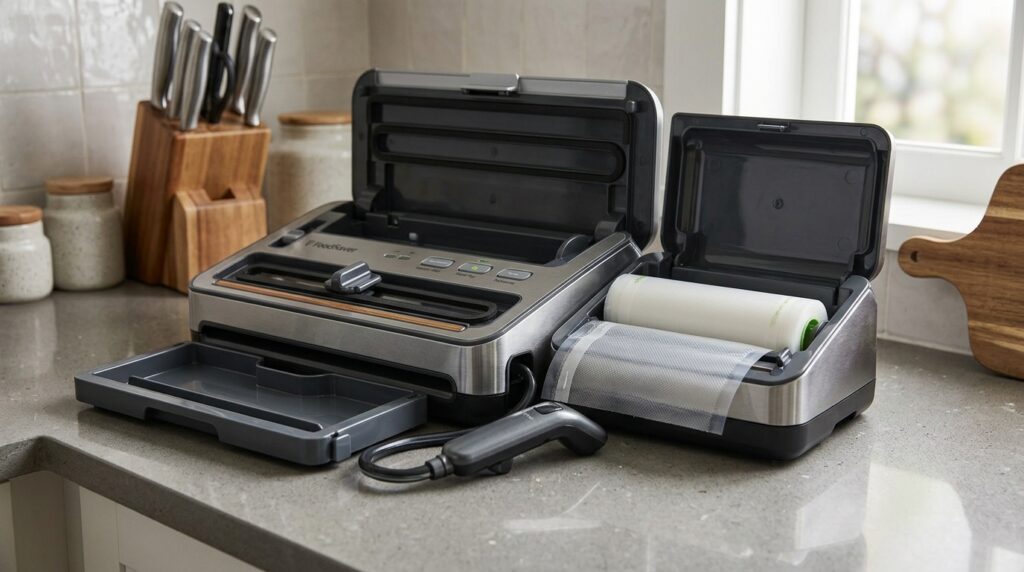
Both machines rely on automatic detection to reduce manual button-pressing, according to manufacturer descriptions. Both include a built-in bag cutter and roll storage compatible with 8″ and 11″ FoodSaver rolls.
The drip trays are removable and dishwasher-safe on both models. The V4840’s listing specifically describes a pull-out drawer design for its tray, which may be a small ergonomic improvement, but this detail comes from retailer copy rather than a side-by-side test.
Countertop dimensions weren’t confirmed for either model in this research, so sizing comparisons are Unknown/Unverified. Both ship with a complete starter kit, so either one is ready to use out of the box. Scattered third-party reviews mention that the automatic detection is easy to use on both, though the sample size behind that feedback is small.
Bags, Accessories, and Compatibility
Both models ship with the same starter kit: an 11″x10′ roll, plus assorted quart and gallon bags and zipper bags. Both support the same bag sizes — 8″ and 11″ FoodSaver rolls and pre-made bags in standard sizes.
Neither manufacturer’s materials address third-party bag compatibility directly. FoodSaver specifies compatible bag widths and formats for its systems, but third-party compatibility is not clearly documented for these two models. Check the exact bag type and model instructions before buying non-FoodSaver rolls.
The V4400 is listed as compatible with FoodSaver jar sealer kits and bottle stoppers through an accessory hose. An equivalent V4840 accessory listing was not confirmed in the sources reviewed, so compatibility should be checked for the exact model before purchase. If you’re wondering can you reuse vacuum seal bags, the answer applies the same way to both models, since it depends on bag material and how they’re cleaned, not the sealer itself.
Warranty, Support, and Long-Term Ownership
Both models carry FoodSaver’s 5-year limited warranty — this is a confirmed fact from manufacturer and retailer listings. Specific exclusion terms weren’t detailed in the research available, so check FoodSaver’s official warranty page for the fine print before you buy.
Both models are supported through the same FoodSaver customer service channels, including parts lookup and warranty claims. FoodSaver publishes model-specific replacement parts for the V4400 (drip tray, seal profile, cutter blade, cutter arm, liquid chamber). Whether an equivalent parts listing exists for the V4840 wasn’t confirmed in this research — worth checking directly if long-term part replacement matters to you.
One retailer page for the V4840 shows a 4.4 out of 5 average rating from 503 buyer ratings. That’s verified buyer feedback tied specifically to that listing — it shouldn’t be assumed to apply to the V4400, which doesn’t have its own confirmed rating figure in this research.
It’s worth being clear here: a 5-year warranty is a company policy, not proof that a product is more reliable. No independent longevity or durability testing was found for either model, so long-term reliability remains an open question for both.
Pros and Cons
FoodSaver V4400
Pros:
- Full 2-in-1 design with automatic and handheld sealing
- Automatic bag and moisture detection
- Built-in roll storage and cutter
- Noted as sous vide compatible by at least one retailer
- 5-year limited warranty
Cons:
- No independently confirmed suction data
- Reviewer-noted liquid pull during wet-food sealing
- No confirmed custom settings feature
- Price not confirmed in this research — verify before buying
FoodSaver V4840
Pros:
- Full 2-in-1 design with automatic and handheld sealing
- Automatic bag and moisture detection
- “3 custom settings” per retailer listing
- Pull-out drawer drip tray design
- 5-year limited warranty, plus a disclosed 4.4/5 buyer rating
Cons:
- No independently confirmed suction data
- “Custom settings” claim not detailed beyond retailer copy
- Sous vide compatibility not explicitly confirmed
- Typically priced higher than base FoodSaver 2-in-1 models
See Current Availability for the V4400,
or
See Current Availability for the V4840.
Which One Is Better for Different Buyers?
Choose the V4400 if:
- You want the standard 2-in-1 feature set without paying for extra settings
- You plan to use sous vide bags and want a listing that confirms this
- You want a straightforward entry point into the FoodSaver lineup
- Price is your main deciding factor and the V4400 is confirmed cheaper
Choose the V4840 if:
- You want the option of multiple custom sealing settings for different foods
- You prefer the pull-out drawer drip tray design
- You’d rather buy based on a larger disclosed buyer-rating sample
- You’re specifically interested in the 4800 Series design and its listed custom-setting feature.
Choose neither if:
- You need a chamber vacuum sealer for consistent heavy-liquid or marinade sealing
- You require independently verified suction or performance benchmarks before buying
- You want a sealer built specifically around liquid-lock technology
If you regularly buy meat in bulk, it’s worth also looking at best vacuum sealers for bulk meat buyers before settling on either FoodSaver model.
Value for Money
Value here shouldn’t be judged on price alone. Based on the research available, the core features are nearly identical between these two models — automatic detection, handheld sealing, roll storage, dishwasher-safe drip tray, and a 5-year warranty. Any price gap should be weighed against the unconfirmed “custom settings” claim on the V4840, not assumed performance gains, since no testing supports a performance difference.
Warranty and support value are equal — both run through the same FoodSaver channels.
The V4400 becomes the better deal when it’s priced meaningfully lower and you don’t need extra sealing settings. The V4840 becomes worth the premium if the custom settings genuinely matter for the foods you seal most, and the price difference stays modest. Since pricing on both changes often, check the current price before buying rather than relying on older figures.
Compare Today’s Price on the V4400.
Final Verdict: FoodSaver V4400 vs V4840
Based on what’s confirmed, no clear overall winner emerges between the FoodSaver V4400 and V4840. The choice comes down to price and whether the V4840’s custom settings matter for how you cook.
The V4400 makes sense as the simpler, likely lower-cost option, with a retailer-confirmed mention of sous vide compatibility. The V4840 makes sense if you want the possibility of extra setting customization, prefer its pull-out drip tray design, or want to weigh a larger disclosed buyer-rating sample before deciding.
For budget buyers, go with whichever model is confirmed cheaper at the time you’re shopping. For frequent users, there isn’t enough evidence to separate the two — both share the same core mechanism. Neither is confirmed as a strong liquid-handling option, so if that’s your main use case, a dedicated liquid-sealing model may serve you better. On support, it’s a tie: same warranty, same service channels.
The biggest open question is the lack of independently verified suction or performance data for either model, along with the unconfirmed depth of the V4840’s “3 custom settings” feature.
If the lower price and a retailer-listed sous vide compatibility claim matter more to you, the V4400 is the more practical pick. If added sealing customization and a larger buyer-rating sample matter more, the V4840 is worth the likely premium.
Check Current Price on the Check FoodSaver V4400 Price
, or
Check Current Price on the FoodSaver V4840 Price.
FAQs
Is the FoodSaver V4840 better than the V4400?
No confirmed performance difference was found between the two. The main differences are price and the V4840’s unconfirmed “custom settings” feature. Weigh those two factors when choosing.
Which has stronger suction, the V4400 or V4840?
Neither manufacturer discloses suction or CFM data for these models. This is Unknown/Unverified — there’s no reliable basis to say one is stronger.
Which is better for sealing meat for the freezer?
Both use automatic vacuum sealing and heat sealing for food storage. FoodSaver markets freshness extensions of up to 5x longer in the freezer across its vacuum-sealing systems, but that is a general manufacturer claim rather than independent testing of these two models.
Which is better for liquids or marinades?
Neither model is marketed with dedicated liquid-lock technology. One reviewer noted liquid pull on the V4400 during a wet-food test, but that’s a single data point, not a generalized spec for either model.
Which has the better warranty?
It’s a tie. Both the V4400 and V4840 carry FoodSaver’s 5-year limited warranty.
Can both models use third-party (non-FoodSaver) bags?
This isn’t clearly addressed in manufacturer materials for either model. FoodSaver specifies compatible bag widths and formats, but third-party compatibility is not clearly documented for these two models. Check the exact bag type and model instructions before buying non-FoodSaver rolls.
Which one should beginners buy?
Both offer automatic bag detection designed to simplify use for first-time buyers. Choose based on current price and whether the V4840’s extra settings are worth the likely premium for your needs.
