
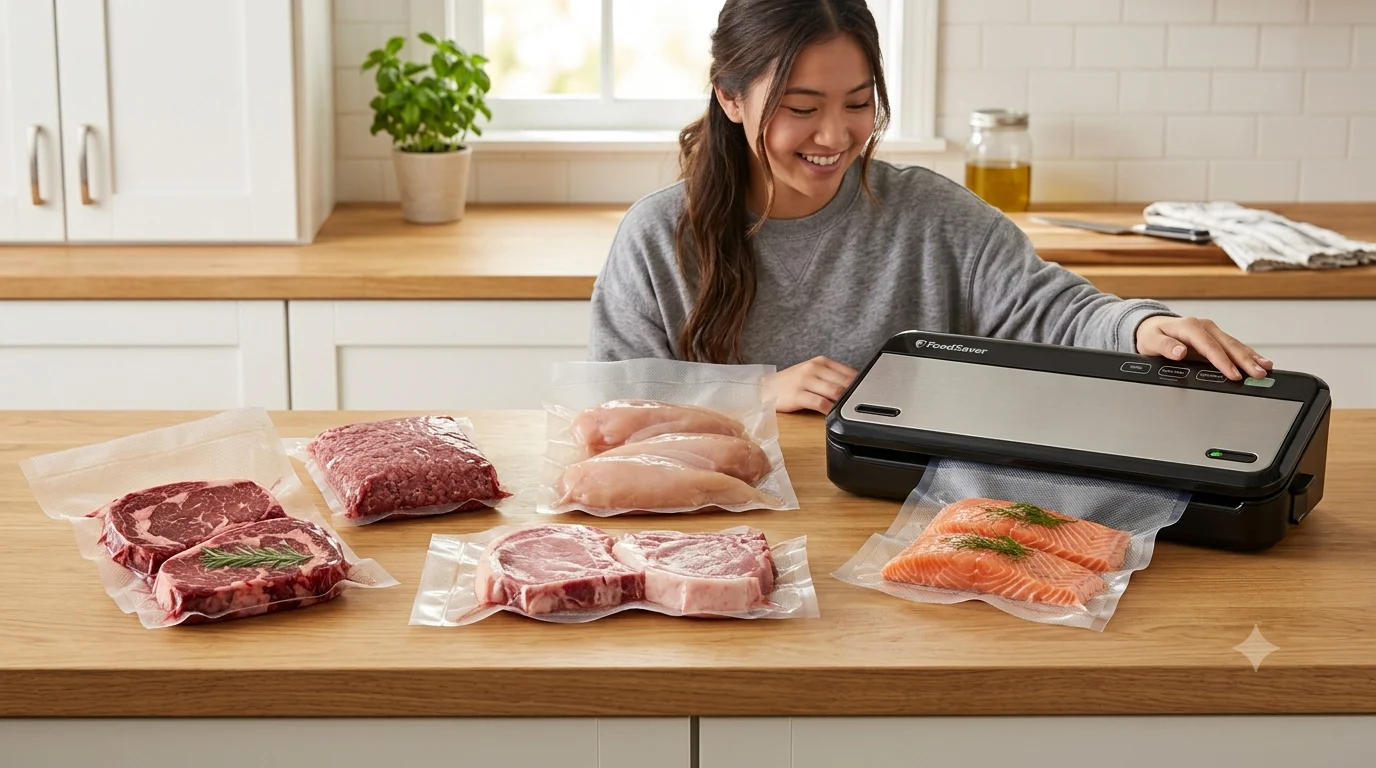
Vacuum sealed meat generally lasts about 1–2 weeks in the refrigerator and 1–3 years in the freezer, compared to just a few days and a few months for the same meat stored without vacuum sealing. The exact number depends on the meat type, storage temperature, seal quality, and how fresh the meat was before sealing.
Quick Answer
| Storage Location | Vacuum Sealed | Not Vacuum Sealed |
|---|---|---|
| Refrigerator | 1–2 weeks | 3–5 days |
| Freezer | 1–3 years | 4–12 months |
These are general ranges. Ground meat, poultry, and fish sit at the shorter end; whole cuts like roasts and steaks sit at the longer end. See the storage chart below for specifics by meat type.

Fridge vs. Freezer: Quick Comparison
| Factor | Refrigerator | Freezer |
|---|---|---|
| Safe temperature | At or below 40°F (4°C) | At or below 0°F (-18°C) |
| Bacterial activity | Slowed, not stopped | Effectively paused |
| Main benefit of vacuum sealing | Reduces oxidation and moisture loss | Prevents freezer burn |
| Typical use case | Short-term (days to ~2 weeks) | Long-term (months to years) |
| Limiting factor | Food safety | Food quality |
In short: the fridge is a safety-limited environment, and the freezer is a quality-limited one. Vacuum sealing helps in both, but for different reasons.
Vacuum Sealed Meat Storage Chart
The ranges below reflect general, USDA-aligned guidance for vacuum sealed meat at proper storage temperatures. Actual shelf life will vary based on meat type, storage temperature, seal quality, and initial freshness.
| Meat | Refrigerator | Freezer | Notes |
|---|---|---|---|
| Beef steak | 1–2 weeks | 1–3 years | Whole cuts hold up well; check seal before long-term storage |
| Beef roast | 1–2 weeks | 1–3 years | Larger cuts freeze well; allow full thaw time before cooking |
| Ground beef | 5–7 days | 6–12 months | More surface area means faster spoilage than whole cuts |
| Pork chops | 1–2 weeks | 1–2 years | Similar pattern to beef steak |
| Pork roast | 1–2 weeks | 1–2 years | Larger cuts generally freeze more evenly than smaller pieces |
| Chicken breast | 1 week | 9 months–1 year | Poultry is more perishable than red meat at the same temperature |
| Turkey | 1 week | 9 months–1 year | Applies to raw turkey parts or whole turkey |
| Bacon | 2 weeks | 6–8 months | Curing agents extend fridge life somewhat; always check the label |
| Fish (lean, e.g., cod) | 4–6 days | 6–8 months | Lean fish generally outlasts fatty fish in the freezer |
| Salmon | 4–6 days | 2–3 months | Higher fat content makes salmon more prone to freezer burn and rancidity over time |
These figures assume the meat was fresh when sealed, the seal is intact, and storage temperatures stayed consistent. Any deviation from those conditions can shorten actual shelf life.

How Long Does Vacuum Sealed Meat Last In The Fridge?
Vacuum sealed meat typically lasts about 1–2 weeks in the refrigerator, longer than the 3–5 days typical for the same meat stored without vacuum sealing.
Vacuum sealing helps by limiting the oxygen available for surface bacteria and slowing moisture loss, which keeps meat from drying out or developing off-flavors as quickly. However, it does not stop bacterial growth entirely. Some spoilage organisms, including certain anaerobic bacteria, grow with little or no oxygen present, and refrigerator temperatures only slow bacterial activity rather than stopping it.
This is why vacuum sealed meat still needs to be refrigerated at or below 40°F (4°C) and evaluated for spoilage signs rather than assumed safe based on packaging alone.
How Long Does Vacuum Sealed Meat Last In The Freezer?
In the freezer, vacuum sealed meat can last anywhere from several months to a few years, depending on the type of meat, with whole cuts like steaks and roasts generally lasting longer than ground meat or fish.
Freezing at 0°F (-18°C) or below effectively pauses bacterial growth, so the freezer’s main limitation is quality rather than safety. The biggest quality risk over time is freezer burn — dehydration and oxidation of the meat’s surface caused by exposure to air. Vacuum sealing directly addresses this by removing the air pocket that allows freezer burn to develop, which is why vacuum sealed meat retains texture, color, and flavor far longer than meat frozen in standard packaging.
Meat stored well past the ranges above is often still safe to eat if it has been kept frozen continuously, but quality — texture, moisture, and flavor — will decline the longer it’s stored.

The Four Factors That Determine Shelf Life
1. Meat Type
Different meats spoil at different rates because of their fat content, moisture level, and surface area exposed to bacteria.
| Meat Type | General Spoilage Pattern |
|---|---|
| Ground meat | Spoils fastest — more surface area means more bacterial exposure |
| Whole cuts (steak, roast) | Spoils slower than ground meat of the same type |
| Poultry | Generally more perishable than red meat at the same temperature |
| Fish and seafood | Among the most perishable; spoils faster than meat or poultry |
| Cured or processed meat (bacon, sausage) | Often lasts longer due to salt, nitrates, or smoking, but always check the label |
2. Storage Temperature
The USDA‘s core guidance is the same whether meat is vacuum sealed or not: perishable meat should be refrigerated at or below 40°F (4°C) and frozen at 0°F (-18°C) or below. Vacuum sealing does not change these safe-temperature thresholds — it slows quality loss and oxidation, but bacterial growth still depends on temperature, not on the packaging alone.
A refrigerator that fluctuates in temperature, or meat left out during transport, shortens shelf life regardless of how well it’s sealed.
3. Packaging Quality
Vacuum sealing only extends shelf life if the seal is intact and the air was fully removed. Watch for:
- Incomplete seals — even a small gap lets air and moisture back in, reducing the benefit
- Bag punctures — bone shards or sharp edges can puncture bags during freezing or handling
- Seal strength — a weak or uneven seal line is more likely to fail over time
A properly vacuum sealed package with no air pockets will consistently outperform a poorly sealed one, even for the same meat type and temperature.
4. Initial Freshness
Vacuum sealing preserves whatever condition the meat was in when it was sealed — it does not improve or reset freshness. Meat that was already close to its use-by date, or that sat unrefrigerated before sealing, will spoil sooner than meat sealed immediately after purchase or processing, even if both are stored identically afterward.
Key Takeaways
- Vacuum sealed meat typically lasts 1–2 weeks in the fridge and 1–3 years in the freezer, but exact timing depends on meat type, storage temperature, seal quality, and initial freshness.
- Vacuum sealing does not stop bacterial growth in the fridge — it slows oxidation and moisture loss, so refrigerated meat still needs a safe temperature and regular freshness checks.
- In the freezer, vacuum sealing mainly protects against freezer burn, which is why sealed meat retains quality far longer than meat in standard packaging.
- Ground meat and fish spoil faster than whole cuts like steaks and roasts, in both the fridge and freezer.
- A properly intact seal and consistent storage temperature matter as much as the storage duration itself.
Signs Vacuum Sealed Meat Has Gone Bad
Regardless of how long it’s been stored, check for these signs before use:
- A broken, loosened, or re-inflated seal
- Grayish-brown discoloration (note: some color change is normal and not always a spoilage sign — pair this with smell and texture)
- A sour, sulfurous, or ammonia-like odor after opening
- A sticky or slimy surface
- Excessive liquid or cloudiness inside the bag
If any of these are present, don’t rely on how long it’s been stored as a reason to use it. When in doubt, USDA guidance is consistent: throw it out.
FAQs
How long does vacuum sealed meat last? It depends on the meat type and storage method. In general, vacuum sealed meat lasts 1–2 weeks in the refrigerator and 1–3 years in the freezer, provided the seal is intact and storage temperatures stay consistent.
How long does meat last in a vacuum seal in the fridge? Typically 1–2 weeks, though ground meat, poultry, and fish are usually on the shorter end of that range, closer to 5–7 days.
How long can vacuum-sealed meat last in the fridge? Up to about 2 weeks under proper refrigeration, but this assumes the meat was fresh when sealed and the seal has remained intact. Always check for spoilage signs rather than relying on time alone.
How long will vacuum-sealed meat last in the freezer? Vacuum-sealed meat can maintain good quality for many months to several years in the freezer, depending on the type of meat and storage conditions, with whole cuts like steaks and roasts on the longer end and ground meat or fish on the shorter end.
How long is vacuum-sealed meat good for once thawed? Once thawed, vacuum-sealed meat should generally be treated like any other thawed meat and used within a few days, since thawing restarts the conditions that allow bacterial growth.
Does vacuum sealing make meat last indefinitely? No. It significantly slows oxidation and freezer burn, but meat quality and safety still depend on storage temperature, seal integrity, and how fresh the meat was before sealing.
Is vacuum sealed meat safe past its sell-by date? A sell-by date is a freshness estimate, not a safety cutoff. If the meat was sealed properly, kept at a safe temperature, and shows no signs of spoilage, it may still be usable — but this should be judged case by case, not assumed.
Why did my vacuum sealed meat spoil faster than expected? The most common causes are an incomplete seal, inconsistent fridge or freezer temperature, or meat that wasn’t fully fresh when it was sealed. Each of these can shorten shelf life independent of the vacuum sealing itself.
Food Safety References
The storage guidance in this article is based on recommendations from:
Storage times are estimates and may vary depending on temperature, packaging quality, and food handling practices.
FreshSealLab — Seal Fresh. Store Smart.

FreshSealLab publishes research-based guides on vacuum sealing, food storage,
and sous vide, referencing USDA and FDA food safety guidance. Content is
reviewed for accuracy and updated as guidance changes.