
Quick Answer
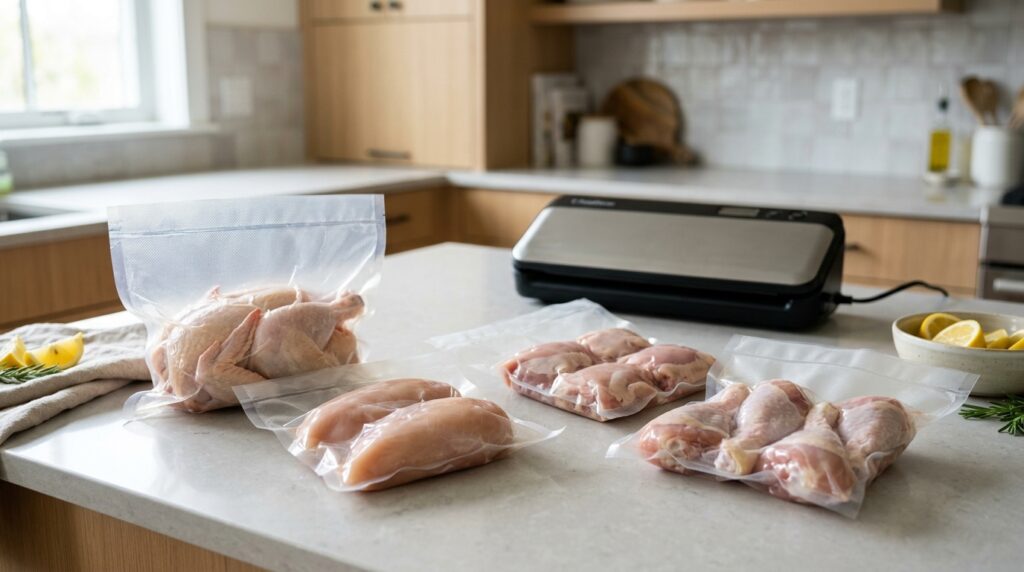
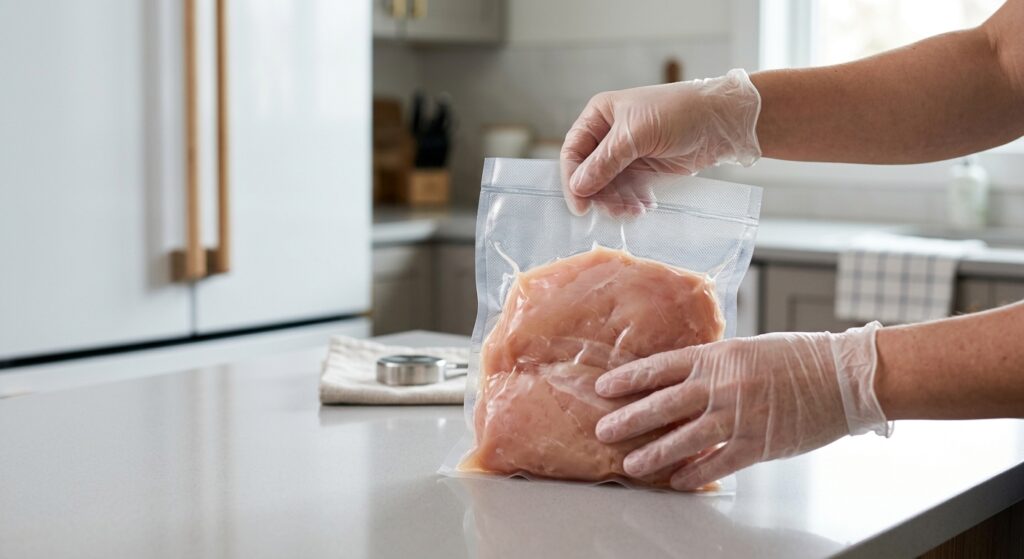
Vacuum sealed chicken last are seen on the table below.
| Chicken type | Refrigerator (40°F / 4°C or below) | Freezer (0°F / -18°C) |
|---|---|---|
| Raw, whole bird | 1–2 days | Best quality within about 1 year |
| Raw breasts, thighs, drumsticks | 1–2 days | Best quality within about 9 months |
| Raw ground or diced chicken | 1–2 days | Best quality within about 6 months |
| Cooked chicken | 3–4 days | Best quality within 4–6 months |
These fridge numbers come from USDA FSIS guidance for raw poultry, not from vacuum sealing specifically. Vacuum sealing does not extend that safety window — it slows quality loss and helps prevent freezer burn. The section below explains why other sites list longer numbers, and which one actually applies to your chicken.
Quality vs. Safety: The Distinction Everything Else Depends On
Two different questions get lumped into “how long does it last,” and mixing them up is where most confusion starts.
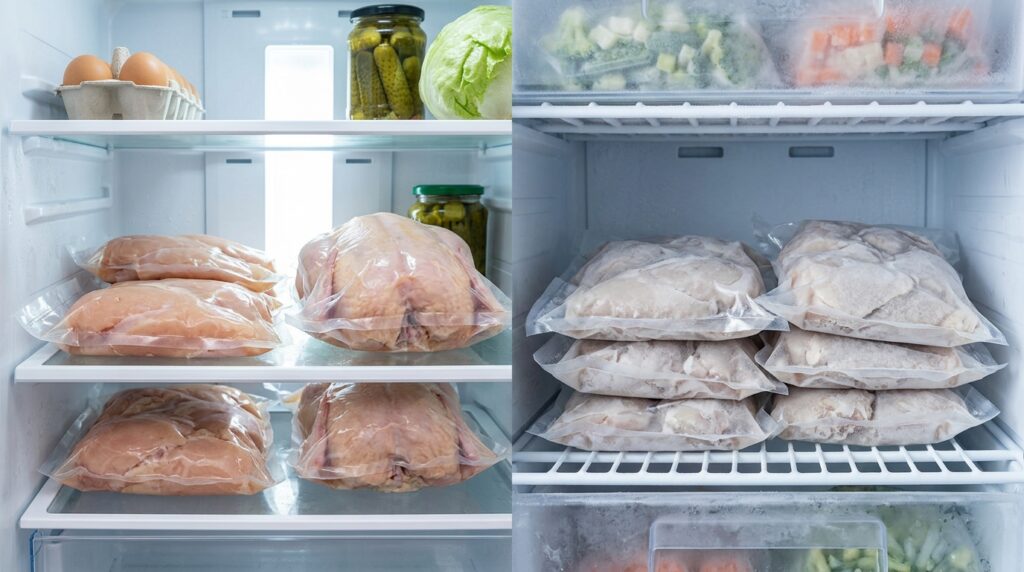
Food safety asks whether harmful bacteria, like Salmonella or Campylobacter, have had time to grow to unsafe levels. This is the question that matters for whether eating the chicken could make you sick. USDA FSIS gives raw poultry a general rule of thumb of 1 to 2 days in the refrigerator, the same window given to fresh poultry, fish, ground meats, and variety meats. This is a conservative, government-set window, not a chicken-specific laboratory study — it applies broadly across raw poultry and ground meats.
Food quality asks whether the chicken still tastes good, holds its texture, and looks appealing. Quality declines gradually and doesn’t follow a hard cutoff the way bacterial risk does. This is where vacuum sealing genuinely helps: removing air limits oxidation and slows the growth of the spoilage organisms that affect taste and smell, so vacuum-sealed chicken can often still look and smell fine well past the point food safety guidance recommends using it.
That gap explains why you’ll see wildly different numbers across the web. A site describing quality retention might say “1–2 weeks” or longer. A site quoting food safety guidance will say “1–2 days.” Both can be technically true for what they’re measuring — but only one of them tells you whether the chicken is safe to eat.
Callout: What vacuum sealing does and doesn’t do Vacuum sealing removes air, which slows oxidation and limits the growth of spoilage bacteria that need oxygen to thrive. That’s a real quality benefit. It does not remove the anaerobic bacteria responsible for foodborne illness risk, and it does not reset or extend the official safety clock on raw poultry. Treat any “vacuum sealing = longer safe fridge life” claim as a quality statement, not a safety one, unless it’s citing FSIS or an equivalent source directly.
Raw Vacuum-Sealed Chicken: Fridge
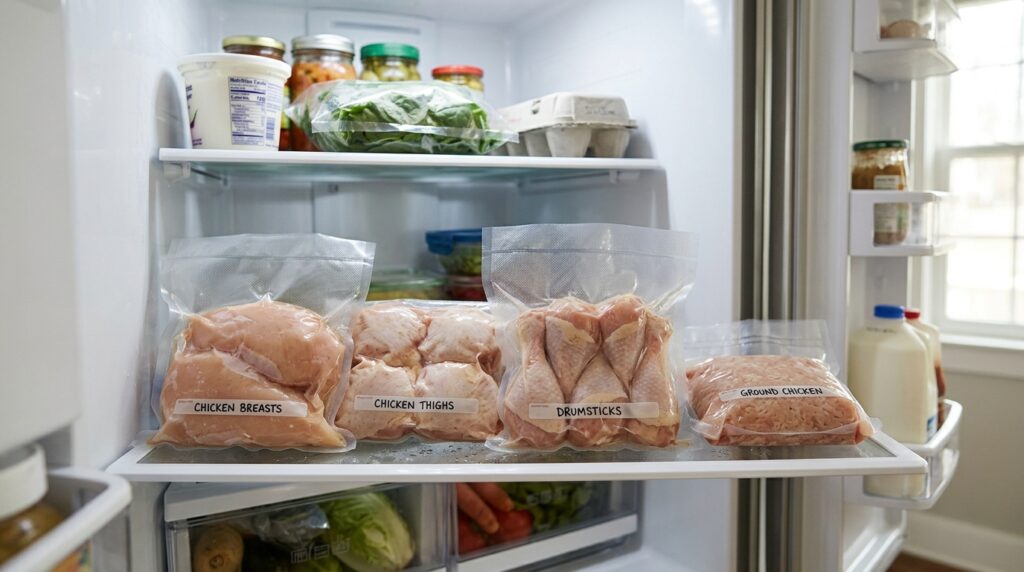
FSIS’s guidance doesn’t change based on packaging — vacuum-sealed raw chicken follows the same 1 to 2 day refrigerator window as chicken stored any other way, provided your fridge holds at 40°F (4°C) or below.
| Format | Typical safe window (raw, refrigerated) | Notes |
|---|---|---|
| Whole bird | 1–2 days | Cook or freeze by day 2 |
| Breasts, thighs, drumsticks | 1–2 days | Same window regardless of cut |
| Ground or diced chicken | 1–2 days | Shortest margin for error of any format |
Ground and diced chicken carries more surface area that was exposed during cutting and grinding, which gives bacteria more contact points to multiply from. That doesn’t mean it spoils meaningfully faster within the 1–2 day window — the official guidance treats it the same — but it’s a reason to be less forgiving with ground poultry if you’re deciding whether to push past day 2.
A few things that affect where you actually land inside that window:
- How long the chicken sat before you sealed it. The 1–2 day clock generally starts from purchase or kill date, not from when you vacuum sealed it. Sealing chicken on day 1 after buying it gives you more real usable time than sealing it on day 2.
- Fridge temperature consistency. A fridge that drifts above 40°F, even occasionally, shortens the safe window.
- Whether raw juices were removed before sealing. Pooled liquid inside the bag can accelerate spoilage and makes it harder to spot early warning signs.
Raw Vacuum-Sealed Chicken: Freezer
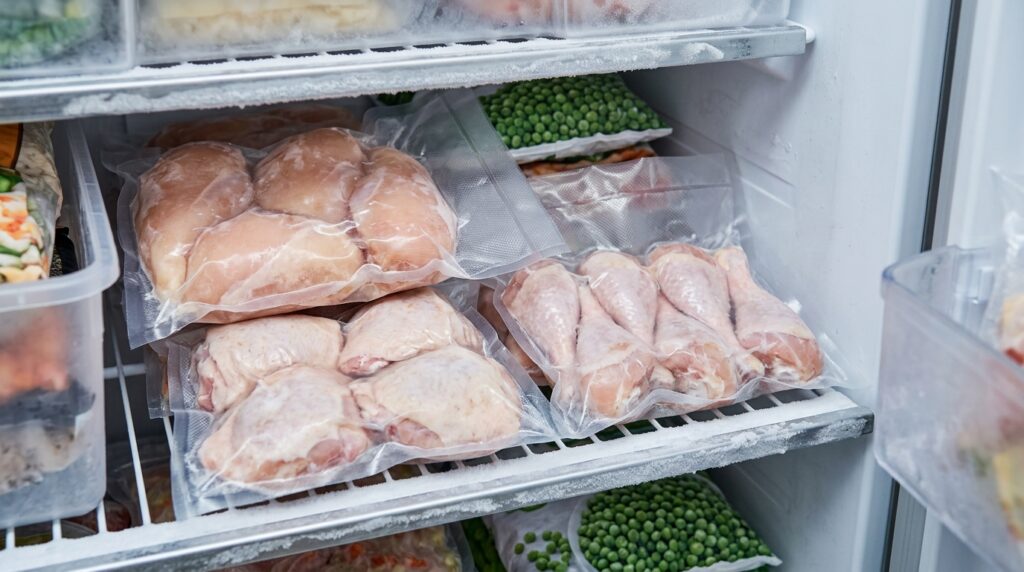
Freezing works differently from refrigeration. Frozen poultry stays safe indefinitely at 0°F or below — freezing halts bacterial growth rather than just slowing it. So the freezer numbers below are quality guidance, not a safety countdown. Chicken kept frozen well past these windows is still safe to eat; it may just lose texture, moisture, or flavor.
| Format | Best-quality window (frozen) | Notes |
|---|---|---|
| Whole bird | Around 1 year | FSIS best-quality guidance for whole raw poultry |
| Breasts, thighs, drumsticks | Around 9 months | FSIS best-quality guidance for poultry parts |
| Giblets | Around 4 months | Shorter window than whole-muscle poultry |
| Ground or diced chicken | Around 6 months | More exposed surface area speeds up freezer-burn related quality loss |
Vacuum sealing’s main freezer benefit is preventing freezer burn — the dry, leathery texture that shows up when air reaches the surface of frozen meat. Because vacuum sealing removes that air, home-sealed chicken can often hold acceptable quality for longer than these general FSIS windows, which were written with standard packaging in mind. There’s no official chicken-specific number for how much longer, so treat any extended range as a reasonable quality estimate rather than a guaranteed figure.
Cooked Vacuum-Sealed Chicken
Cooked chicken follows a different, shorter clock than raw chicken once it’s been cooled and stored.
| Refrigerator | Freezer (quality) |
|---|---|
| 3–4 days | 4–6 months |
FSIS guidance allows cooked chicken to be kept in the refrigerator for three to four days, longer than the 1–2 day window for raw poultry, because cooking reduces the bacterial load to begin with. Vacuum sealing cooked chicken before refrigerating can help preserve texture and reduce the risk of picking up other fridge odors, but the 3–4 day guidance still applies — sealing it doesn’t extend that window.
A couple of scenarios worth flagging:
- Meal-prepped chicken sealed the same day it’s cooked gets the full 3–4 day window from the cooking date, not from a later sealing date.
- Sous vide chicken cooked and chilled properly, then vacuum sealed, generally falls under the same cooked-chicken guidance rather than a separate raw-poultry rule, but if you’re holding sous vide chicken for extended periods at controlled temperatures rather than refrigerating it normally, that’s a distinct food-safety topic outside the scope of this article — follow sous vide–specific time-and-temperature guidance for that use case.
Commercial vs. Home Vacuum-Sealed Chicken
Not all vacuum-sealed chicken is the same product, and the right rule of thumb depends on which one you have.
Store-bought, factory-sealed chicken usually carries a “use-by” or “sell-by” date set by the processor, based on their specific packaging method, processing conditions, and sometimes modified-atmosphere packaging rather than a true vacuum. When that date is present, it’s more reliable than a general rule of thumb — follow the printed date rather than the ranges in this article.
Home-sealed chicken, sealed with a countertop vacuum sealer after purchase, doesn’t have a processor-set date. That’s when the general FSIS-based ranges above apply, and why tracking your own seal date (or purchase date) matters more for home-sealed poultry than for factory-sealed packages.
Why the Number Varies So Much
If you’ve searched this question before landing here, you’ve probably seen numbers anywhere from a couple of days to two weeks. A few real variables explain most of that spread:
- Fridge temperature. A fridge running close to 40°F behaves differently than one running colder or occasionally drifting warmer.
- Purchase date vs. seal date. The safety clock generally starts when the chicken was purchased or processed, not when you sealed it.
- Raw vs. cooked. These follow different windows entirely — 1–2 days vs. 3–4 days.
- Whole muscle vs. ground. Ground and diced formats have more exposed surface area, which is a food-safety consideration even within the same official window.
- Seal integrity. A weakened or partially failed seal behaves more like unsealed storage.
- Whether the source is describing safety or quality. This is the single biggest reason numbers diverge — see the Quality vs. Safety section above.
Decision Tree: Is My Vacuum-Sealed Chicken Still Good?
Use this as a general troubleshooting guide, not a substitute for your own judgment or official guidance if you’re uncertain.
1. Is it within the fridge window (1–2 days raw, 3–4 days cooked) from purchase or cook date?
- Yes → Generally fine to use, assuming the fridge stayed at 40°F or below and the seal is intact.
- No → Go to step 2.
2. Is it past the window, but the seal is intact with no odor, discoloration, or sliminess?
- This is where food safety and food quality guidance diverge. Official guidance treats “past the window” as a signal to discard raw poultry, even if it looks fine, because bacteria that cause illness aren’t something you can see or smell. If you’re past the safety window, the cautious choice is to discard the raw chicken rather than rely on appearance alone.
- For cooked chicken past 3–4 days, the same principle applies — discard rather than judge by smell.
3. Are there visible signs of spoilage: off odor, gray or greenish tint, sliminess, or a bag that’s lost its vacuum or ballooned?
- Any of these → Discard. A lost seal, ballooning, or cloudy liquid inside the bag can indicate bacterial gas production, and that’s not a quality issue you can cook away.
Warning: Never taste raw or cooked chicken to check if it’s still good. Off smell, texture, or a compromised seal are your signals — not taste-testing.
Practical Checklist: Before You Vacuum Seal Raw Chicken
A few habits that make the fridge and freezer numbers above more reliable:
- Keep chicken refrigerated at 40°F or below until you’re ready to seal it.
- Pat chicken dry and remove excess surface liquid before sealing — pooled juice inside the bag can accelerate spoilage and interferes with sealing quality.
- Seal as soon as practical after purchase, and track that date rather than relying on memory.
- Label the bag with the seal date, not just the “type” of chicken, so the fridge or freezer clock is easy to check later.
- Keep raw chicken bags away from ready-to-eat food in the fridge, even when sealed, to avoid cross-contamination if a seal fails.
FAQs
Does vacuum-sealed chicken need to be used by its “use-by” date even if it looks and smells fine? For store-bought chicken with a processor-set use-by date, yes — that date reflects the specific product and packaging, and appearance or smell isn’t a reliable way to detect the bacteria that cause foodborne illness. For home-sealed chicken without a printed date, the general FSIS-based windows above are the reference point.
Can you refreeze vacuum-sealed chicken after thawing it in the fridge? Chicken that was thawed in the refrigerator (not on the counter or in warm water) can generally be refrozen safely, though quality may decline somewhat with each freeze-thaw cycle. Chicken thawed using faster methods, like cold water or a microwave, should be cooked before refreezing.
Is store-bought vacuum-sealed chicken safe past its printed date if unopened? An unopened package past its “sell-by” date may still be safe if it’s been refrigerated properly and the seal is intact, since sell-by dates are about retailer stock rotation rather than a hard safety cutoff. A “use-by” date is more conservative and is the one to follow closely.
Does marinating chicken before vacuum sealing change how long it lasts? Marinating doesn’t extend the raw poultry safety window — the 1–2 day refrigerator guidance still applies once chicken is raw and marinating in the fridge. Acidic marinades can affect texture over time but don’t function as a safety extension.
Why does ground or diced chicken spoil faster than a whole vacuum-sealed chicken breast? Cutting and grinding exposes more surface area to potential contamination during processing, giving bacteria more places to take hold. Official guidance keeps ground poultry within the same 1–2 day window as other raw poultry, but it’s the format with the least margin if you’re deciding whether to push toward the end of that window.
Can you tell if vacuum-sealed chicken has gone bad just by looking at the seal? A lost vacuum, visible ballooning, or cloudy liquid inside the bag are useful warning signs and can indicate bacterial activity. But an intact seal with no visible signs doesn’t guarantee the chicken is still within a safe window — seal condition is one signal among several, not a standalone test.
Related Reading
- How Long Does Vacuum Sealed Food Last?
- How Long Does Vacuum Sealed Meat Last?
- How Long Does Vacuum Sealed Steak Last?
- How To Vacuum Seal Meat
